

📚 Guide by Safety Mom · Allstar Enviro Safety — H2s Alive Certification Calgary Oil Workers — a Safety Mom · Allstar Enviro Safety guide for Canadian oil & gas, construction, and industrial workers. Written and reviewed by Arliss Levine, CRSP, CHSC, Calgary lead safety instructor.
🔗 Related Safety Mom courses & guides: H2S Alive Calgary · What is H2S gas? · Oil Sands Safety Certs · Instructor: Arliss Levine, CRSP, CHSC
You’ll need H2S Alive certification to work in Calgary’s oil and gas industry since hydrogen sulfide gas can kill within minutes of exposure. The 8-hour certification course teaches you vital gas detection, respiratory protection, and rescue techniques through hands-on training. You’ll learn to use essential safety equipment like SCBAs and follow strict protocols. Understanding these life-saving skills will open doors to better job opportunities and prepare you for real-world challenges ahead.
Key Takeaways
- H2S Alive certification is mandatory for Calgary oil workers and must be renewed every three years to maintain compliance.
- The certification requires completing an 8-hour course covering gas detection, respiratory protection, rescue techniques, and emergency protocols.
- Participants must pass a written exam with 70% minimum score and demonstrate practical skills including proper SCBA use.
- Training includes hands-on experience with safety equipment and simulated emergency scenarios in H2S environments.
- Certification improves job prospects while ensuring workers can protect themselves and others from deadly H2S gas exposure.
What Is H2S Gas and Why It’s Dangerous
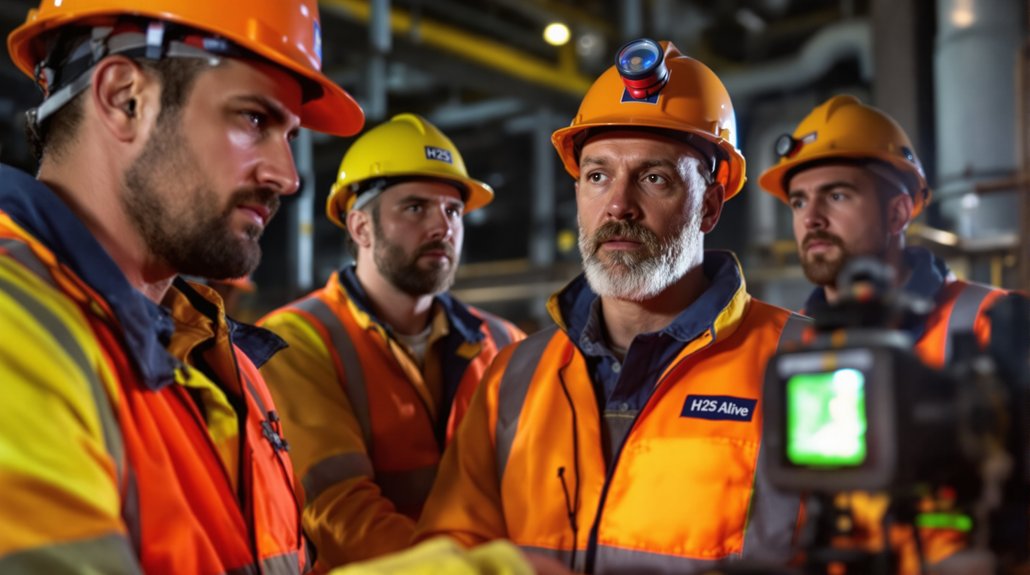
H2S, or hydrogen sulfide, is a highly toxic gas that smells like rotten eggs at low concentrations but can quickly deaden your sense of smell at higher levels. You’ll find this colorless gas commonly in oil and gas operations, where it occurs naturally in geological formations and as a byproduct of drilling.
What makes H2S particularly dangerous is its ability to cause rapid unconsciousness and death with just a few breaths at high concentrations. Even at lower levels, you’ll experience symptoms like headaches, dizziness, and respiratory issues. The gas is heavier than air, so it collects in low-lying areas and confined spaces, creating hazardous pockets that you might unexpectedly encounter. Since H2S can disable your sense of smell, you can’t rely on odor alone to detect its presence. Prolonged exposure to this toxic gas can lead to permanent eye damage and chronic respiratory problems that may persist long after exposure.
Legal Requirements and Industry Standards
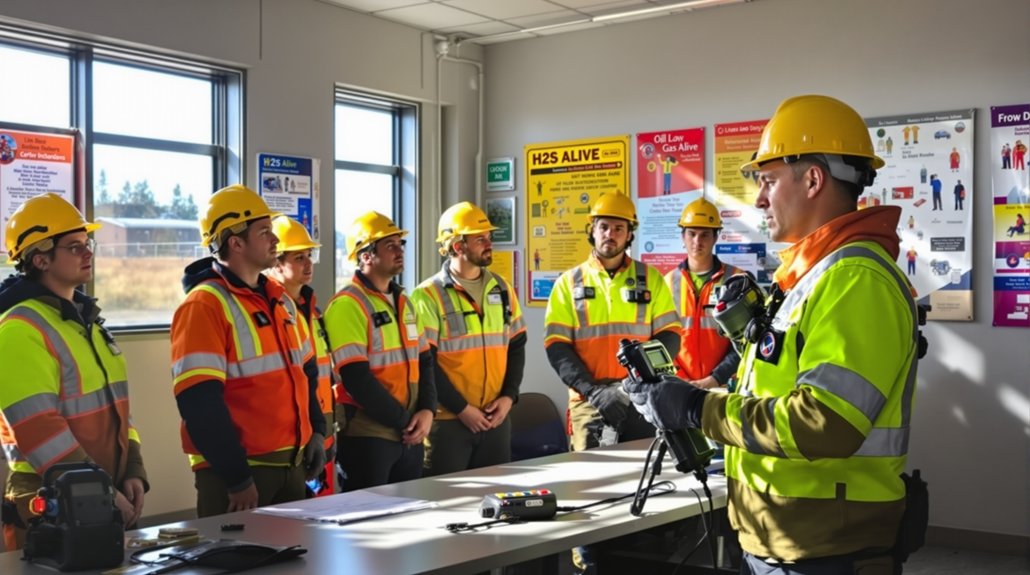
Given the severe risks of H2S exposure, Alberta’s Occupational Health and Safety regulations mandate that all workers in environments with potential H2S presence must hold valid H2S Alive certification.
You’ll need to renew your certification every three years to maintain compliance with industry standards. The Energy Safety Canada (ESC) oversees the H2S Alive program and sets strict guidelines for training providers. Your employer must guarantee you complete the certification before allowing you to work in areas where H2S might be present.
The certification aligns with Canadian Standards Association (CSA) requirements and the Alberta Oil and Gas Industry’s best practices. If you’re working on sites with H2S concentrations of 10 ppm or higher, you must also carry appropriate personal monitoring equipment and respiratory protection at all times.
Workers must demonstrate their physical ability to lift 50 pounds and properly use respiratory equipment during certification training.
Core Components of H2S Alive Training

The extensive H2S Alive training program consists of four essential modules: gas detection, respiratory protection, rescue techniques, and emergency response protocols.
You’ll learn to operate and maintain various H2S detection devices, including personal monitors and portable units. The respiratory protection module teaches you how to properly fit, inspect, and use Self-Contained Breathing Apparatus (SCBA) and other protective equipment.
In rescue techniques, you’ll practice safe drag methods, learn to assess hazardous situations, and master the use of rescue equipment. The emergency response section covers evacuation procedures, communication protocols, and proper documentation.
Each module includes hands-on practice sessions where you’ll demonstrate your skills in simulated emergency scenarios. You must pass both written and practical assessments to earn your certification.
Successful completion of the program grants you three-year certification from Energy Safety Canada.
Personal Protective Equipment and Safety Protocols
When working around hydrogen sulfide gas, proper personal protective equipment (PPE) serves as your primary defense against exposure. You’ll need to wear an approved self-contained breathing apparatus (SCBA), chemical-resistant gloves, steel-toed boots, and protective eyewear at all times in H2S-risk areas.
Your safety protocols must include conducting gas tests before entering confined spaces, maintaining continuous monitoring with personal H2S detectors, and establishing clear emergency evacuation routes. You’re required to check your equipment daily, ensuring proper fit and functionality of your respiratory protection. Always work with a partner using the buddy system, maintain upwind positioning when possible, and know the location of your nearest safe breathing air. Never attempt to rescue others without wearing appropriate PPE first. Regular gas detector calibration every 6-12 months is essential to ensure accurate readings and reliable safety monitoring.
Emergency Response and Rescue Procedures
Proper preparation for H2S emergencies goes beyond wearing protective equipment – you’ll need to master specific rescue protocols and response procedures. During your H2S Alive certification, you’ll learn how to perform quick rescues while ensuring your own safety first.
You’ll practice emergency breathing techniques, victim assessment, and proper drag techniques to move unconscious workers to safety. The course will teach you to recognize various exposure symptoms and provide appropriate first aid responses, including CPR if necessary.
You must also learn to activate emergency response systems, coordinate with rescue teams, and properly document incidents. Understanding wind direction, establishing a command post, and securing the hazard zone are essential skills you’ll develop to manage H2S emergencies effectively.
Real-life incidents have shown that swift emergency response actions are critical for preventing H2S fatalities.
Certification Process and Validity Period
Getting your H2S Alive certification requires completing an intensive 8-hour course that combines classroom theory with hands-on training. You’ll need to pass both a written exam and practical assessment to receive your certification, which remains valid for three years from the date of completion.
- Course includes essential respiratory protection equipment training and proper mask-fitting procedures
- Written exam requires a minimum score of 70% to pass
- Practical assessment tests your ability to perform rescue operations and use safety equipment
- Upon successful completion, you’ll receive a wallet-sized certification card
- Recertification is mandatory every three years to maintain valid credentials
To maintain your certification’s active status, you should schedule your recertification course about one month before your current certification expires. Most employers in Calgary’s oil industry won’t let you work without a valid H2S Alive certificate. A blended renewal option launched in 2020 allows students with unexpired certificates to complete the theory portion online at their convenience.
Real-World Applications in Calgary’s Oil Fields
Throughout Calgary’s oil fields, you’ll encounter numerous situations where H2S Alive training becomes essential for your safety. You’ll need to apply your H2S knowledge when working near wellheads, storage tanks, pipelines, and processing facilities where this deadly gas might be present. Your certification proves invaluable during drilling operations, maintenance work, and emergency response scenarios.
Your training comes into play when you’re testing H2S monitoring equipment, implementing emergency shutdown procedures, or conducting gas testing before entering confined spaces. You’ll use your skills to properly wear and maintain respiratory protection equipment, and you might need to perform rescue operations in H2S-contaminated areas. The certification also helps you identify potential leak sources and understand wind direction indicators for safe work positioning. With blended learning options now available, workers can complete theoretical portions online within 30 days before hands-on practical training.
Frequently Asked Questions
Can I Take the H2S Alive Course if I Don’t Speak English Fluently?
You’ll need good English comprehension for H2S Alive since safety instructions and emergency protocols are taught in English. Consider taking ESL classes first or finding a course in your language.
What Happens if I Fail the Written or Practical Exam?
Don’t panic! You’ll get another shot. If you fail either exam, you can retake it at no extra cost. Most training centers let you retry within 30 days.
Are There Any Medical Conditions That Disqualify Me From Certification?
You’ll need medical clearance if you have respiratory issues, heart conditions, or panic disorders. Contact your healthcare provider and the certification authority to discuss any specific medical concerns.
Do Other Countries Recognize the H2S Alive Certification From Canada?
Your Canadian H2S Alive certification is recognized in many countries, but you’ll need to verify specific requirements with employers, as some regions may require additional local certifications or training.
Can I Get Reimbursed for the Course Through My Employer?
You’ll likely get reimbursed if your employer requires H2S training. Many companies cover safety certification costs – just save your receipt and check your company’s specific reimbursement policy.
Additional Safety Knowledge
Understanding H2S — The Basics
Hydrogen sulphide (H2S) is a colourless, flammable gas heavier than air with a characteristic rotten-egg odour at low concentrations. It is produced naturally by anaerobic decomposition of organic matter and is present in sour oil and gas reservoirs, sewer systems, wastewater treatment, pulp and paper operations, tanneries, and manure storage pits. In Alberta’s upstream oil and gas industry it is the single most common atmospheric hazard.
Exposure Concentrations and Effects
- 0.01–1.5 ppm: detectable by smell — the classic rotten-egg odour.
- 10 ppm: Alberta occupational exposure limit (OEL) 8-hour time-weighted average.
- 15 ppm: Alberta 15-minute short-term exposure limit (STEL).
- 50–100 ppm: eye irritation, respiratory discomfort, olfactory fatigue (sense of smell disappears — a dangerous false-safety signal).
- 100 ppm: NIOSH Immediately Dangerous to Life or Health (IDLH) limit.
- 500–700 ppm: loss of consciousness within minutes, respiratory paralysis, death likely without immediate rescue.
- 1,000 ppm and above: single-breath knockdown — instant collapse and death.
Detection and Personal Monitoring
Every worker in a potential H2S atmosphere must carry a personal 4-gas monitor calibrated for H2S detection. Standard alarm setpoints are 10 ppm (low alarm) and 15 ppm (high alarm). Bump testing is required before every shift; full calibration every 30 days minimum. Fixed detection systems with visual and audible alarms are required at facilities with continuous H2S risk.
H2s Alive Certification Calgary Oil Workers — Emergency Response
The first response to an H2S alarm is not to investigate — it is to evacuate upwind and uphill (H2S is heavier than air). Muster at the designated point, complete roll call, and notify the incident commander. Rescue attempts require Self-Contained Breathing Apparatus (SCBA), a trained rescue partner, and a documented rescue plan. Attempting rescue without SCBA is the leading cause of secondary H2S fatalities.
Content reviewed by Arliss Levine, CRSP, CHSC — lead safety instructor at Safety Mom · Allstar Enviro Safety Calgary, an Energy Safety Canada Authorized Training Provider.
