

📚 Guide by Safety Mom · Allstar Enviro Safety — H2s Alive Vs H2s Awareness — a Safety Mom · Allstar Enviro Safety guide for Canadian oil & gas, construction, and industrial workers. Written and reviewed by Arliss Levine, CRSP, CHSC, Calgary lead safety instructor.
🔗 Related Safety Mom courses & guides: H2S Alive Calgary · What is H2S gas? · Oil Sands Safety Certs · Instructor: Arliss Levine, CRSP, CHSC
If you work in oil and gas, petrochemical, or drilling operations, you’ll need H2S Alive certification to meet industry standards. While H2S Awareness provides basic safety knowledge in a 2-4 hour course, H2S Alive offers extensive 8-hour training with hands-on rescue techniques and breathing apparatus practice. Your job role and exposure risk level will determine which certification you need, but H2S Alive’s thorough training can make the difference in life-threatening situations.
Key Takeaways
- H2S Alive certification is mandatory for oil, gas, and drilling operations, while H2S Awareness suffices for lower-risk industries.
- H2S Alive provides comprehensive hands-on training with breathing apparatus, making it the industry standard for high-risk environments.
- The three-year validity of H2S Alive certification meets OSHA requirements, compared to H2S Awareness’s typical one-year validity.
- H2S Alive’s 8-hour duration includes practical rescue techniques, whereas H2S Awareness offers 2-4 hours of basic theoretical instruction.
- Companies requiring workers to operate in areas with H2S concentrations above 100 ppm must choose H2S Alive certification.
Understanding H2S Gas and Its Workplace Hazards
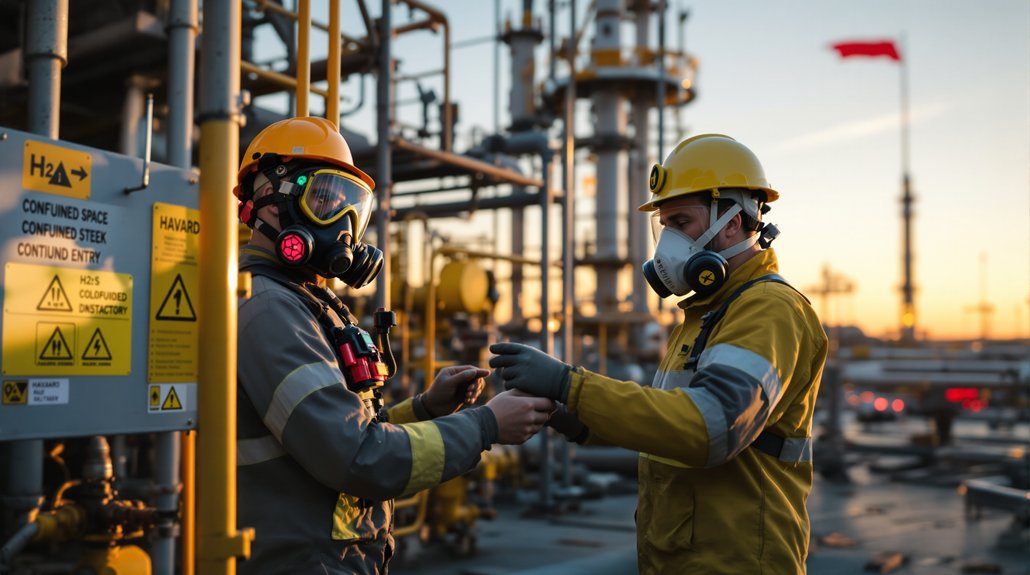
When working in industries where hydrogen sulfide (H2S) gas is present, understanding its characteristics and dangers is essential for survival.
You’ll need to recognize that H2S is a colorless, highly toxic gas that smells like rotten eggs at low concentrations but can quickly deaden your sense of smell at higher levels. This makes it particularly dangerous, as you won’t be able to rely on odor detection alone.
H2S is heavier than air and collects in low-lying areas, confined spaces, and poorly ventilated locations. You’ll find it commonly in oil and gas operations, sewage treatment facilities, and mining sites.
At concentrations above 100 ppm, H2S can cause rapid unconsciousness, and exposure to levels exceeding 1000 ppm can lead to immediate collapse and death.
Chronic exposure can result in permanent eye damage and vision impairment that may persist long after exposure ends.
Key Differences Between H2S Alive and H2S Awareness Training
Given the serious risks of H2S exposure, proper training becomes a top priority for workplace safety.
H2S Alive and H2S Awareness courses serve different purposes and depth levels of training.
H2S Alive is a thorough certification program that includes hands-on training with breathing apparatus, practical rescue techniques, and detailed gas detection procedures. You’ll need to pass both written and practical exams to receive certification, which typically remains valid for three years.
H2S Awareness, on the other hand, offers basic knowledge about H2S hazards and safety protocols. It’s usually delivered online or in classroom settings without practical components.
This course focuses on recognition, reporting, and evacuation procedures rather than rescue operations. You won’t receive certification for emergency response scenarios, making it suitable for workers who don’t directly handle H2S-related tasks.
The rotten egg smell of H2S gas can become undetectable at high concentrations, making proper training crucial for worker safety.
Industry Requirements and Regulatory Compliance
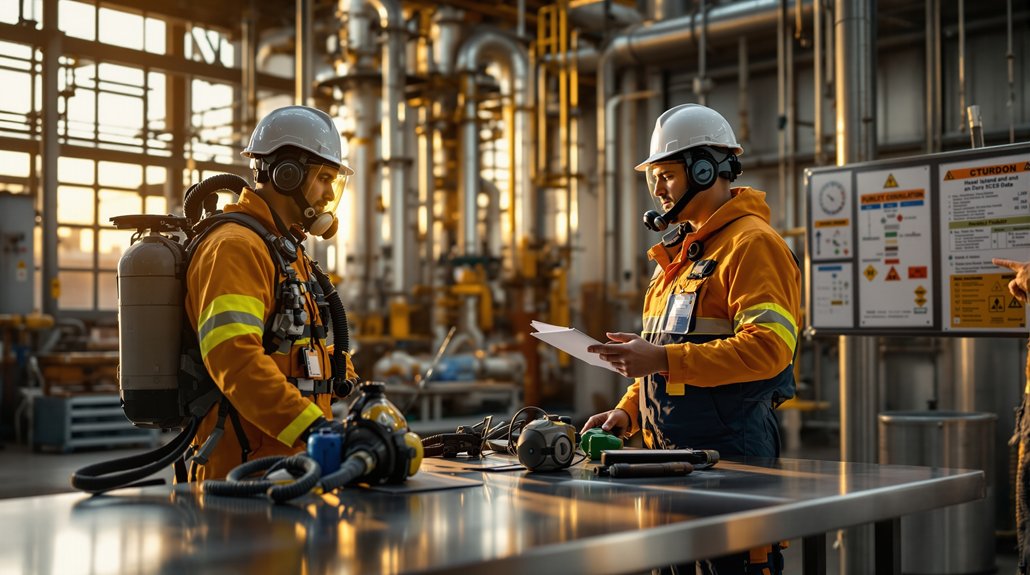
Different industries have distinct requirements for H2S safety training based on worker exposure risks and regulatory frameworks.
If you’re working in oil and gas, petrochemical, or drilling operations, you’ll typically need H2S Alive certification to meet regulatory standards. This certification is mandatory in most Canadian provinces and many U.S. states for high-risk environments.
H2S Awareness training may suffice if you’re in industries with lower exposure risks, such as wastewater treatment or laboratory work.
However, you’ll need to verify your specific jurisdiction’s requirements, as regulations can vary by location and job role.
While OSHA doesn’t mandate a specific H2S training program, they require employers to provide adequate safety training for workers who might encounter H2S in their workplace.
Renewal of H2S certification is required every three years to maintain compliance and ensure workers stay current with safety protocols.
Course Content and Certification Duration
Although both courses cover H2S safety fundamentals, H2S Alive offers a more extensive 8-hour program compared to H2S Awareness’s typical 2-4 hour duration.
In H2S Alive, you’ll learn advanced rescue techniques, hands-on breathing apparatus training, and emergency response protocols. The certification is valid for three years and includes practical assessments.
H2S Awareness focuses on basic safety concepts, hazard recognition, and general emergency procedures. You’ll receive theoretical instruction without the hands-on component, and the certification typically expires after one year.
While Awareness provides essential knowledge for low-risk environments, H2S Alive’s extensive curriculum prepares you for direct involvement in high-risk scenarios where H2S exposure is more likely.
Students must demonstrate their ability to use protective safety equipment including SCBA, gas monitors, and chemical-resistant gear during the certification process.
Cost Analysis and Return on Investment
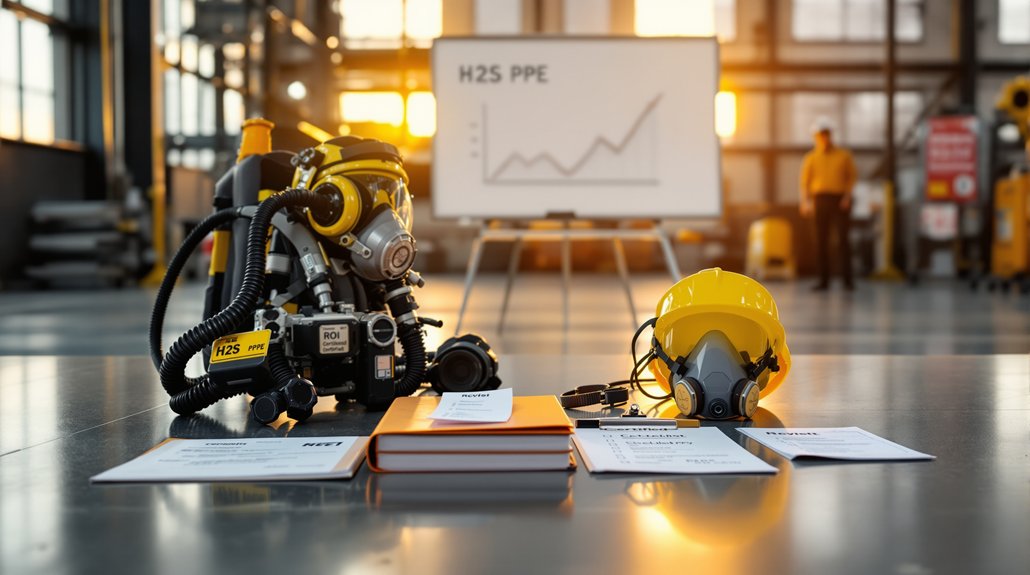
The investment requirements for these two courses reflect their depth of training. H2S Alive typically costs between $200-300, while H2S Awareness ranges from $50-100.
You’ll find that H2S Alive’s higher price point comes with hands-on training, certified instructors, and industry-recognized certification that’s valid for three years.
While H2S Awareness is more budget-friendly, it’s important to take into account your career goals. If you’re working directly in high-risk H2S environments, the return on investment for H2S Alive justifies its cost through thorough safety training and broader job opportunities.
However, if you’re in a support role with minimal H2S exposure, the awareness course might provide sufficient knowledge for your needs at a lower cost.
Both courses should include essential training on gas detection methods to ensure worker safety in confined spaces.
Frequently Asked Questions
Can I Transfer My H2S Certification Between Different Provinces or Countries?
You can transfer your H2S Alive certification across Canadian provinces, but international recognition varies. You’ll need to verify specific requirements with your employer or local regulatory authorities.
What Happens if I Fail the Practical Assessment Portion?
If you fail the practical assessment, you’ll need to retake that portion of the course. Most training providers offer same-day retests or schedule you for another attempt within a week.
Are There Any Physical Requirements or Medical Conditions That Disqualify Participants?
You’ll need to be physically able to wear a breathing apparatus and perform rescue procedures. Medical conditions affecting breathing, heart problems, or severe claustrophobia may disqualify you from participation.
How Soon Before Expiration Should I Renew My H2S Certification?
You’ll want to renew your H2S certification 1-3 months before it expires. Don’t wait until the last minute, as some employers require valid certificates to continue working on-site.
Do Online H2S Courses Provide the Same Employment Opportunities as In-Person Training?
You’ll have better employment prospects with in-person H2S training since many employers specifically require classroom-based certification, especially for H2S Alive, which isn’t available in online-only format.
Additional Safety Knowledge
Understanding H2S — The Basics
Hydrogen sulphide (H2S) is a colourless, flammable gas heavier than air with a characteristic rotten-egg odour at low concentrations. It is produced naturally by anaerobic decomposition of organic matter and is present in sour oil and gas reservoirs, sewer systems, wastewater treatment, pulp and paper operations, tanneries, and manure storage pits. In Alberta’s upstream oil and gas industry it is the single most common atmospheric hazard.
Exposure Concentrations and Effects
- 0.01–1.5 ppm: detectable by smell — the classic rotten-egg odour.
- 10 ppm: Alberta occupational exposure limit (OEL) 8-hour time-weighted average.
- 15 ppm: Alberta 15-minute short-term exposure limit (STEL).
- 50–100 ppm: eye irritation, respiratory discomfort, olfactory fatigue (sense of smell disappears — a dangerous false-safety signal).
- 100 ppm: NIOSH Immediately Dangerous to Life or Health (IDLH) limit.
- 500–700 ppm: loss of consciousness within minutes, respiratory paralysis, death likely without immediate rescue.
- 1,000 ppm and above: single-breath knockdown — instant collapse and death.
Detection and Personal Monitoring
Every worker in a potential H2S atmosphere must carry a personal 4-gas monitor calibrated for H2S detection. Standard alarm setpoints are 10 ppm (low alarm) and 15 ppm (high alarm). Bump testing is required before every shift; full calibration every 30 days minimum. Fixed detection systems with visual and audible alarms are required at facilities with continuous H2S risk.
H2s Alive Vs H2s Awareness — Emergency Response
The first response to an H2S alarm is not to investigate — it is to evacuate upwind and uphill (H2S is heavier than air). Muster at the designated point, complete roll call, and notify the incident commander. Rescue attempts require Self-Contained Breathing Apparatus (SCBA), a trained rescue partner, and a documented rescue plan. Attempting rescue without SCBA is the leading cause of secondary H2S fatalities.
Content reviewed by Arliss Levine, CRSP, CHSC — lead safety instructor at Safety Mom · Allstar Enviro Safety Calgary, an Energy Safety Canada Authorized Training Provider.
