

You can get Standard First Aid with CPR in Calgary over one intensive weekend that teaches hands‑on CPR for all ages, AED use, choking relief, bleeding control, shock and wound care, splinting, and scene safety. Choose an accredited provider like Alberta Health Services or Canadian Red Cross, check instructor credentials and certification verification, and expect practical practice and a skills assessment. Come prepared with precourse review and note-taking tips, and keep going to learn how to retain and renew your skills.
Key Takeaways
- Find accredited Calgary providers (Alberta Health Services, Canadian Red Cross) offering Standard First Aid with CPR in a weekend format.
- Confirm the course covers primary/secondary assessments, CPR for all ages, AED use, choking, bleeding, and shock management.
- Verify instructor credentials, course codes, class size limits, hands-on practice, and practical assessment requirements.
- Choose weekend schedules with classroom demos, practice rotations, and a final practical evaluation for real-time skill testing.
- Check certification validity, renewal policies, replacement card availability, and meet CSA National Standard for workplace first aid.
What a One‑Weekend Standard First Aid CPR Course Covers in Calgary
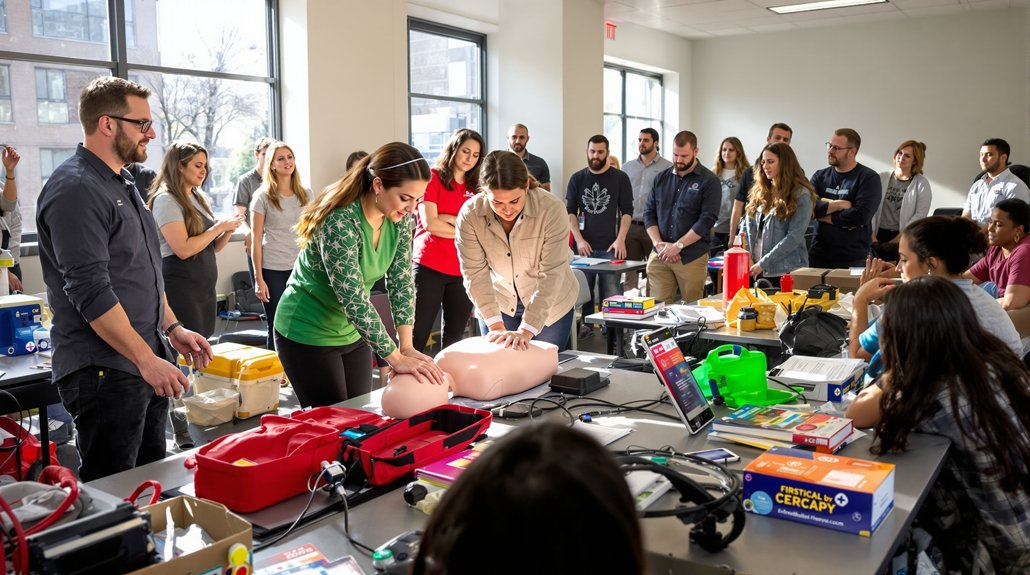
A one‑weekend Standard First Aid CPR course in Calgary gives you hands‑on training in life‑saving skills and the confidence to act in an emergency.
You’ll learn primary and secondary assessments, CPR for adults, children and infants, automated external defibrillator (AED) use, and choking relief.
The course covers controlling bleeding, shock management, burns, fractures, and spinal injury precautions.
You’ll practice wound care, splinting, and bandaging, plus scene safety and legal/ethical considerations.
Training mixes demonstrations, guided practice, and realistic scenarios so you build practical competence, not just theory.
Upon completion you’ll receive certification valid for the standard period, documentation for employers, and the readiness to respond calmly and effectively when incidents occur. This course meets the CSA National Standard for workplace first aid curriculum, ensuring comprehensive training.
Who Should Take Weekend Certification and Which Level Fits Your Needs?
Choose the level that fits how much responsibility you’ll have.
- A retail worker picturing a shopper collapsing and stepping in confidently.
- A daycare provider imagining a child choking and needing prompt, calm intervention.
- A wilderness leader visualizing stabilizing an injured hiker until help arrives.
If you’re an occasional caregiver or parent, Basic-level skills often suffice.
If you supervise others, work in childcare, construction, or remote settings, opt for Standard First Aid with CPR Level C.
Employers often state required levels; match their expectation to avoid gaps in both skills and compliance. Additionally, certification is valid for 3 years upon completion, ensuring your skills stay current and effective.
How to Choose an Accredited Calgary Provider and Verify Certification
Now that you’ve picked the right level, pick a reliable Calgary provider so your certification actually counts. Look for organizations accredited by recognized bodies like Alberta Health Services or the Canadian Red Cross.
Check the provider’s website for course codes, instructor credentials, and clear renewal policies. Read recent student reviews and confirm class size limits to guarantee adequate hands-on time.
Verify certification authenticity by asking to see sample certificates and the issuing agency’s verification process—some list certificates online or provide a unique ID you can confirm.
Confirm validity period and provincial acceptance for workplaces or licensing bodies. Finally, choose providers who offer replacement cards and digital records, so you can quickly prove your credentials when employers or regulators request them. Additionally, ensure the provider emphasizes hands-on training to equip you with essential life-saving skills.
What to Expect During the Weekend : Schedule, Hands‑On Practice, and Assessment
Expect a structured weekend that balances short classroom sessions, plenty of hands-on practice, and a practical assessment so you leave confident and certified.
You’ll follow a clear schedule: introductions, skill demonstrations, practice rotations, breaks, and a final evaluation. Instructors guide you through scenarios, correct your technique, and answer questions so you master compressions, breaths, AED use, and bandaging.
You’ll move between stations to work in pairs or small groups and repeat skills until they feel natural. The practical assessment tests real-time performance under observation rather than rote answers, and successful completion earns your certificate.
- You’ll feel the resistance of proper chest compressions on a manikin
- You’ll hear AED prompts and simulate shock delivery
- You’ll practice wound control and splinting in realistic setups
Tips to Prepare Beforehand and Retain Skills After Certification
After you’ve completed the weekend’s practice and assessment, spend a little time preparing so the skills stick.
Before the course, review online modules, watch short CPR demos, and practice chest compressions on a pillow to get a feel for depth and cadence.
Bring a notebook and jot down key steps, common mistakes, and instructor tips during class.
After certification, schedule brief monthly refreshers: five‑minute practice on a manikin or surface, and quiz yourself on recovery position and choking response.
Use phone reminders for skill checks and renewals.
Join a local first aid group or volunteer to keep scenarios realistic.
Regular, focused repetition beats cramming—maintain confidence by practicing often and learning from each refresh.
Frequently Asked Questions
Do Employers Cover Course Costs or Require Specific Providers?
Sometimes they do cover costs or require specific providers; you should check your employer’s policy, get written confirmation, and ask HR about approved courses, reimbursement procedures, and any required instructor credentials before enrolling.
Is There a Language Interpreter or Translated Materials Available?
Yes — you can request language interpreters or translated materials; providers often offer them for groups or upon request, but you’ll need to contact the specific training organization in advance to confirm availability and any extra fees or arrangements.
Are Refresher Micro-Sessions Offered Online Between Recertifications?
Yes — you can access short online refresher micro-sessions between recertifications to reinforce skills, review protocols, and stay current. They’re self-paced, interactive, and designed to fit into your schedule for ongoing confidence and competence.
Can Religious or Medical Exemptions Affect Certification Requirements?
Yes — you can request religious or medical exemptions, but they don’t automatically waive certification. You’ll need to provide documentation, work with the certifying agency or employer, and they’ll decide alternative training, accommodations, or acceptable substitutes.
What Accommodations Exist for Participants With Physical Disabilities?
You can request physical accommodations like modified practice stations, adaptive equipment, extra time, alternative assessment methods, or one-on-one instruction; organizers’ll often work with you to guarantee access, but you should notify them in advance to arrange support.
