

You work in settings where hydrogen sulfide is common and can kill quickly if unmanaged. Oil and gas workers—drilling crews, platform operators, and plant maintainers—face high risk from sour wells and leaks. Wastewater and sewer crews encounter unpredictable H2S during confined‑space entry and line work. Farmers and manure handlers see spikes during agitation and storage. Any confined‑space entrant, rescuer, or mechanic around storage tanks must use continuous monitors and strict permits — keep going to learn specific controls and roles.
Key Takeaways
- Oil and gas extraction and production workers (drilling crews, platform operators) face high H2S risk from sour wells and processing equipment.
- Refinery and petrochemical plant operators and maintenance mechanics encounter H2S in units, storage tanks, and upset conditions.
- Wastewater and sewer workers (confined-space entrants, line cleaners) risk H2S from anaerobic decomposition in manholes and sewer lines.
- Agriculture and livestock handlers (manure pit attendants, slurry pump operators) face rapid H2S release during agitation and storage handling.
- Confined-space entrants and rescue teams across industries have elevated H2S exposure risk without proper testing, ventilation, and monitoring.
What H2S Is, How Exposures Happen, and Key Exposure Limits

Hydrogen sulfide (H2S) is a colorless, flammable gas with a characteristic rotten-egg odor that acts as a potent respiratory and central nervous system toxin; you encounter it when organic matter decomposes anaerobically, in petroleum and natural gas operations, wastewater treatment, and certain mining or agricultural settings. You should note H2S properties: high lipid solubility, rapid absorption via lungs, and heavier-than-air behavior that creates low-lying accumulation. Exposures happen acutely from confined-space releases, equipment failure, or process upsets and chronically at low concentrations. You’ll monitor concentration with detectors, enforce ventilation, and use respirators where controls can’t eliminate risk. Recognize exposure symptoms — eye and respiratory irritation, headache, dizziness, nausea, and at high levels unconsciousness or respiratory paralysis — and act immediately per exposure limits and emergency protocols. Completing an H2S Alive course provides essential training for those entering high-risk environments.
Oil, Gas & Petrochemicals : H2S Sources and At‑Risk Roles

Having covered what H2S is and how exposures occur, we’ll focus on oil, gas, and petrochemical operations where H2S is frequently encountered and poses varied risks. You’ll find H2S in sour wells, processing units, storage tanks, and sour gas pipelines; fugitive emissions and upset conditions concentrate the hazard. Roles at highest risk include drilling crews, completions, platform operators, process technicians, maintenance mechanics, and pipeline inspectors. You must rely on continuous H2S detection, work permits, and engineering controls to reduce exposure. Administrative controls and personal protective equipment supplement controls, but they’re secondary to prevention. Regular, task-specific safety training is essential: it enforces monitoring protocols, emergency response, and correct respirator use. Additionally, participants must have a current H2S Alive certificate to ensure proper training and knowledge are maintained for safety compliance. Apply a layered, documented approach to keep personnel safe.
Wastewater & Sewers : H2S Risks, Typical Tasks, and Controls
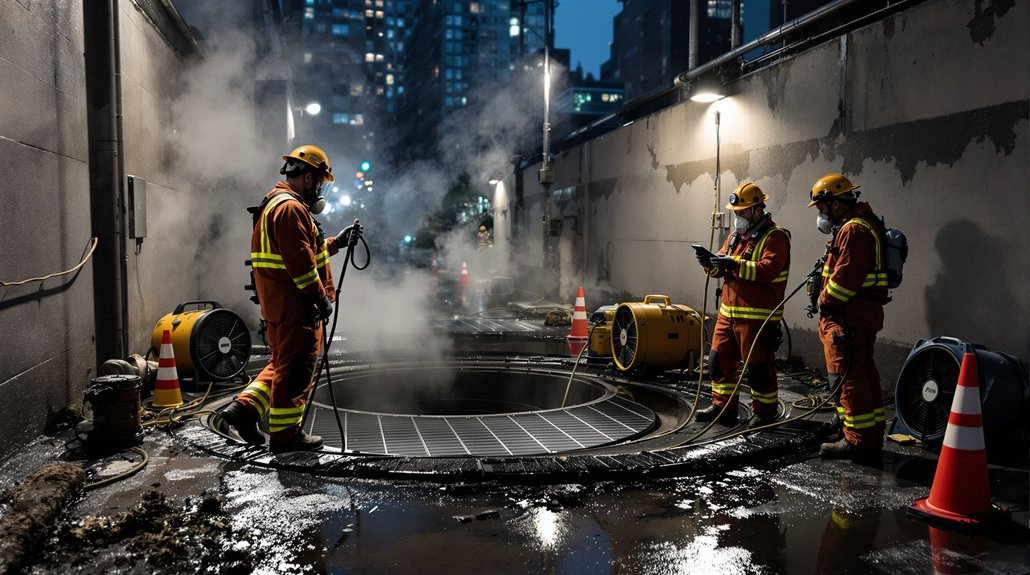
Because sewers and wastewater systems host anaerobic decomposition, you’ll commonly encounter hydrogen sulfide (H2S) at concentrations that can rise quickly and unpredictably. You work in wastewater treatment and sewer maintenance where confined spaces, submerged lines, lift stations, and sludge handling concentrate H2S. Typical tasks include entering manholes, cleaning lines, inspecting pumps, and sampling influent/effluent. Controls you must follow are continuous area and personal H2S monitoring, atmospheric testing before and during entry, forced ventilation, and isolation of affected lines. Use intrinsically safe instruments, calibrated detectors, and escape‑respirators when exposure limits are exceeded. Implement confined‑space permits, trained standby attendants, and emergency rescue plans. Regular maintenance, odour control, and operational adjustments reduce biochemical generation and lower worker risk. Additionally, understanding confined space definitions is crucial for ensuring safety during these operations.
Agriculture & Manure Management : Who’s Exposed and How to Reduce Risk

When you manage manure storage, lagoons, barns, or silage piles, anaerobic pockets and agitation can produce rapidly rising H2S levels that put farmworkers, livestock handlers, and contractors at risk; assess exposure by identifying confined spaces, recent agitation or rainfall events, and operations that disturb settled solids. You should map tasks with potential for H2S release—manure handling, slurry pumping, agitation, and crust-breaking—and quantify frequency, duration, and worker proximity. Control measures include ventilation, remote agitation methods, exclusion zones, and gas-resistant PPE selected to measured concentrations. Implement routine monitoring protocols, strict entry permission procedures, and documented decontamination steps. Train supervisors and crews via targeted safety training that covers hazard recognition, detector use, and emergency communication. Review controls after incidents and whenever processes or weather change.
Confined‑Space Work : Responders, Contractors, Monitoring, and Emergency Steps
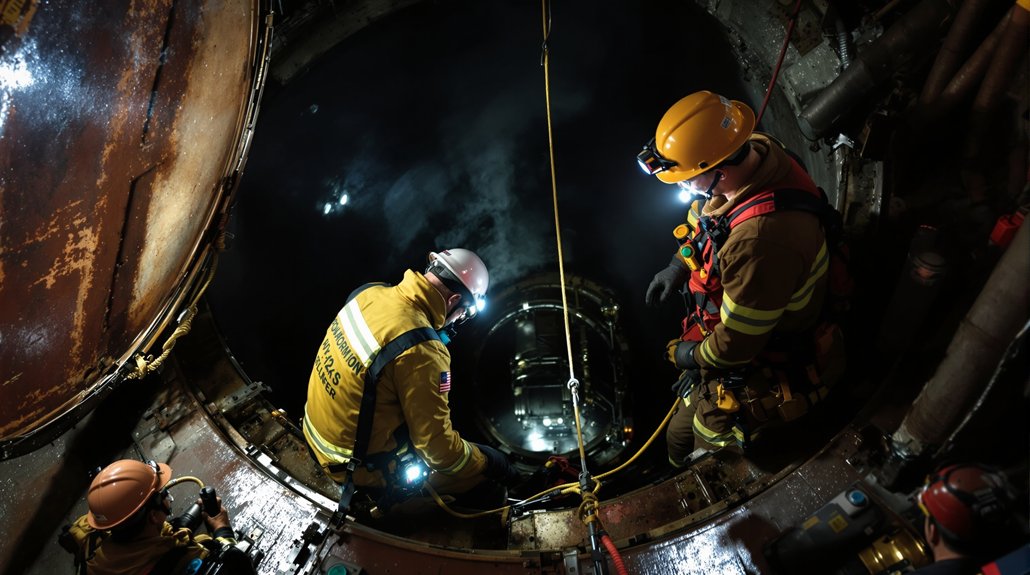
If you enter or work near confined spaces where H2S can accumulate, you must treat every entry as a potential high‑risk operation and organize responders, contractors, monitoring, and emergency steps before any task begins. You’ll assign trained entry supervisors and standby responders, guarantee contractors follow the same permit-to-work system, and verify roles in writing. You’ll deploy continuous fixed or portable H2S monitors with alarm thresholds, calibrate instruments before use, and record readings. You’ll confirm ventilation limits and use forced-air systems where needed. You’ll rehearse emergency procedures, establish communication links, and pre-position rescue equipment and self-contained breathing apparatus. You’ll limit personnel, enforce PPE, maintain entry logs, and suspend operations immediately on alarm to protect workers in confined spaces.
Frequently Asked Questions
Can H2S Cause Long-Term Neurological Damage at Low Exposures?
Yes — you can experience subtle neurological effects from repeated low exposure to H2S; studies suggest cumulative low-level exposure may cause cognitive, mood, and motor changes, though evidence varies and long-term risk remains under investigation.
Are Home Carbon Monoxide Detectors Effective for H2S Detection?
No — you can’t rely on a carbon monoxide detector for H2S; carbon monoxide detector effectiveness targets CO sensors, not hydrogen sulfide, so you’d need dedicated H2S detectors or multi-gas monitors calibrated for accurate H2S detection.
Do Commonly Used Respirators Protect Against H2S Indefinitely?
No — you can’t rely on commonly used respirators to protect against H2S indefinitely; respirator efficiency decreases with filter saturation and breakthrough, and safe use depends on exposure duration, maintenance, cartridge type, and monitored gas concentrations.
Is H2S Odor Perception a Reliable Warning for Danger?
No — you can’t rely on odor perception as a warning; H2S odor threshold varies, and detection reliability is poor because olfactory fatigue, individual sensitivity, and rapid incapacitation can prevent noticing dangerous concentrations. Use monitors and alarms.
What First Aid Should Be Given to Someone Exposed to H2S?
You should remove the person from exposure, call emergency services, start first aid including airway support and rescue breathing if needed, monitor essential signs, decontaminate clothing, and follow emergency procedures until professional help arrives.
