

📚 Guide by Safety Mom · Allstar Enviro Safety — Why First Aid Certification Could Save Your Career In Oil And Gas — a Safety Mom · Allstar Enviro Safety guide for Canadian oil & gas, construction, and industrial workers. Written and reviewed by Arliss Levine, CRSP, CHSC, Calgary lead safety instructor.
🔗 Related Safety Mom courses & guides: Standard First Aid Calgary · Certificate validity by province · Oil Sands Safety Certs · Instructor: Arliss Levine, CRSP, CHSC
First aid certification isn’t just a box to check – it’s becoming essential for your oil and gas career survival. You’ll need it to meet strict safety regulations, qualify for most operational roles, and stand out in a competitive industry. Whether you’re handling chemical burns, confined space rescues, or platform evacuations, these life-saving skills make you invaluable. The deeper you explore safety certifications, the more doors will open in this high-stakes sector.
Key Takeaways
- First aid certification is mandatory for most oil and gas positions, making it essential for maintaining employment and legal compliance.
- Increased industry expansion and stricter safety regulations have made first aid certification a crucial differentiator in job applications.
- Companies prioritize safety-certified personnel for supervisory roles, creating more career advancement opportunities for certified professionals.
- Remote locations and high-risk environments require immediate emergency response capabilities, making certified personnel invaluable to operations.
- Certification demonstrates safety consciousness and professional commitment, giving candidates a competitive edge in hiring and promotions.
The Growing Demand for Safety-Certified Personnel

As the oil and gas industry continues to expand globally, companies are increasingly seeking professionals with extensive first aid certifications. You’ll find that safety regulations have become stricter, making certified personnel more valuable than ever. Industry leaders now prioritize workplace safety to reduce accidents, minimize liability, and protect their workforce. Professionals working at remote sites should complete Standard First Aid training, which provides advanced knowledge over two comprehensive days of instruction. You’ll notice that job postings frequently list first aid certification as a mandatory requirement, not just a preferred qualification. This trend reflects the industry’s commitment to maintaining high safety standards across all operations. Whether you’re working on an offshore platform, at a refinery, or in field operations, having updated first aid credentials will set you apart from other candidates and demonstrate your commitment to workplace safety. It’s become a critical factor in career advancement and job security.
Real-World Applications in High-Risk Environments
When working in the oil and gas industry, you’ll encounter numerous high-risk scenarios that require immediate first aid response. From chemical burns and crush injuries to falls and electrical accidents, you’ll need to act quickly and confidently to save lives.
Your first aid skills will prove invaluable during platform evacuations, where you might need to treat hypothermia or drowning victims. You’ll also face unique challenges like H2S exposure, which demands specialized response protocols. In remote drilling locations, you’ll often be the first responder before medical help arrives.
Your certification prepares you for confined space rescues, managing pressure-related injuries, and responding to fire-related trauma. These real-world applications extend beyond basic CPR, equipping you with skills to handle industry-specific emergencies that occur miles from the nearest hospital. Understanding real-life H2S incidents has proven critical in developing effective emergency response strategies that save lives in the field.
Career Advancement and Competitive Edge
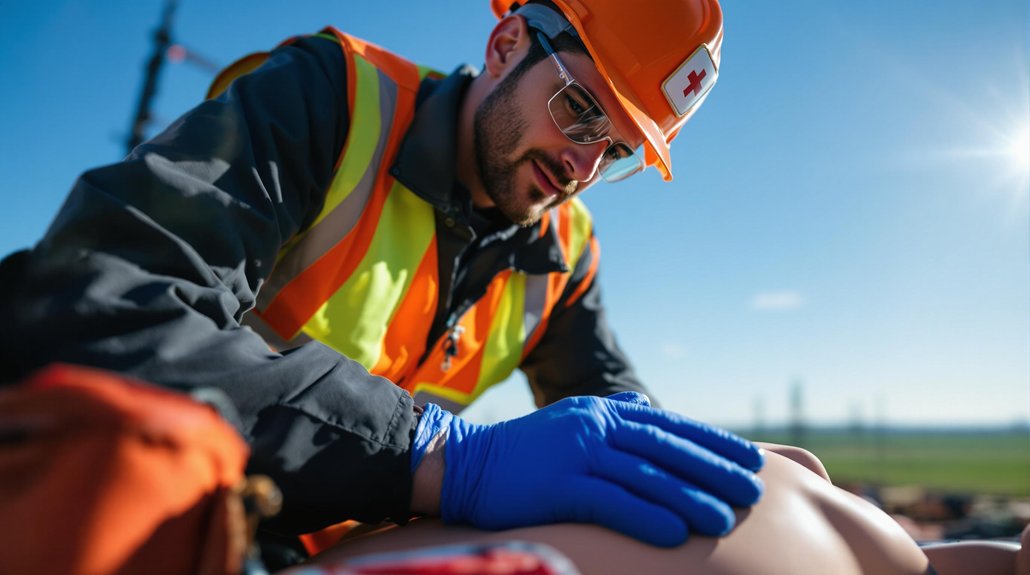
First aid certification can dramatically boost your career prospects in the oil and gas industry. Companies prioritize safety-conscious professionals who can respond effectively during emergencies, making you a more valuable team member. With this qualification, you’ll stand out among job candidates and position yourself for supervisory roles.
You’ll find that many senior positions require first aid certification as a prerequisite, especially for offshore assignments and remote locations. Having this credential demonstrates leadership potential and commitment to workplace safety. It’s also a stepping stone to advanced safety certifications and specialized roles in emergency response teams. When promotion opportunities arise, your first aid certification could be the differentiating factor that sets you apart from equally qualified colleagues. The CSA National Standard certification ensures your training meets rigorous industry requirements across multiple provinces.
Legal Requirements and Industry Standards
Because safety regulations are strictly enforced in the oil and gas sector, first aid certification isn’t just recommended – it’s mandatory for most operational roles. You’ll need to comply with OSHA standards and specific industry requirements that vary by state and region. Most companies require at least basic first aid and CPR certification, while offshore positions demand additional emergency response training.
You’re legally obligated to maintain current certification and complete periodic refresher courses to stay compliant. Major industry standards like API RP 75 and SEMS guidelines explicitly outline first aid requirements for different job functions. If you’re working on drilling rigs or production platforms, you’ll need specialized certifications such as offshore medical emergency training. Non-compliance can result in hefty fines, job suspension, or termination. Workers must also complete H2S Alive training to safely handle hydrogen sulphide gas exposure risks in petroleum industry environments.
Training Options and Certification Pathways

Meeting these legal requirements starts with choosing the right training program and certification path. You’ll find three main options: in-person training at accredited facilities, blended learning programs combining online modules with hands-on practice, and on-site training at your workplace. Each pathway leads to different certification levels, from basic first aid to advanced emergency response.
For entry-level positions, you’ll need at least a basic first aid certificate, which takes 6-8 hours to complete. Mid-level roles often require intermediate certification with specialized modules in petroleum industry hazards. Senior positions and offshore work demand advanced certification, including trauma management and remote emergency care. Most certificates are valid for two to three years, after which you’ll need to complete a refresher course to maintain your qualification.
Frequently Asked Questions
How Long Does a First Aid Certification Typically Remain Valid?
Your First Aid certification typically remains valid for 2-3 years, but you’ll need to check with your specific certifying organization as expiration periods can vary by provider and region.
Can First Aid Certification From Another Country Be Recognized Internationally?
Your first aid certification’s international recognition depends on where you got it. While some certificates are widely accepted globally, you’ll often need to verify or recertify in your destination country.
What Happens if I Fail the First Aid Certification Exam?
If you fail your first aid certification exam, you’ll need to retake it. Most training providers offer a free retest within 30 days, but you’ll need additional practice beforehand.
Are There Physical Requirements or Medical Conditions That Disqualify Candidates?
You’ll need physical ability to perform CPR and basic lifts. Severe heart conditions, untreated seizures, or mobility issues that prevent kneeling/compressions may disqualify you from certification.
Does My Employer Have to Pay for My First Aid Recertification?
Your employer isn’t legally required to pay for first aid recertification, but many companies cover these costs since it’s a job requirement and benefits workplace safety. You should check your company’s policy.
Additional Safety Knowledge
Alberta Workplace First Aid Requirements
Alberta OHS First Aid Regulation categorises workplaces by hazard type (low, medium, high) and distance from an emergency medical facility. Requirements scale from a Type 1 first aid kit for low-hazard offices to a full first aid room with a trained attendant and rescue equipment for remote high-hazard sites. Every employer must post the names of designated first aiders and maintain a first aid record book.
The Primary Survey — ABCDE
Every first aid response follows a standard primary survey to identify life-threatening conditions in priority order:
- A — Airway: is it clear? Foreign object, tongue, swelling? Perform head-tilt/chin-lift if no spinal injury suspected.
- B — Breathing: is the casualty breathing normally? Look, listen, feel for 10 seconds.
- C — Circulation: check for signs of life, severe bleeding, shock.
- D — Disability: level of consciousness (AVPU: Alert, Voice-responsive, Pain-responsive, Unresponsive), neurological signs.
- E — Environment/Exposure: protect from environment, expose injuries for assessment, prevent hypothermia.
CPR — Current Guidelines
Adult CPR: compressions at 100–120 per minute, depth of 5–6 cm (2–2.4 inches), full recoil between compressions, minimise interruptions. Compression-to-ventilation ratio is 30:2 for single rescuers. Child (1 year to puberty): use one or two hands depending on size, compress about 1/3 the depth of the chest. Infant (under 1 year): use two fingers, compress 4 cm (1.5 inches). AED should be applied as soon as available — every minute of delay reduces survival by 7–10%.
Why First Aid Certification Could Save Your Career In Oil And Gas — Certification Levels
Alberta workplace first aid levels: Emergency First Aid (basic, 8 hours, 3-year validity), Standard First Aid (comprehensive, 16 hours, 3-year validity), and Advanced First Aid or Wilderness First Aid for remote workplaces. CPR levels A (adult), C (adult/child/infant), and BLS/HCP (healthcare provider level with two-rescuer CPR). Recertification must be completed before expiry — expired tickets require full retraining.
Content reviewed by Arliss Levine, CRSP, CHSC — lead safety instructor at Safety Mom · Allstar Enviro Safety Calgary, an Energy Safety Canada Authorized Training Provider.
