

📚 Guide by Safety Mom · Allstar Enviro Safety — Alberta oil & gas workers encounter hydrogen sulfide (H2S) across drilling operations, sour gas wells, gathering systems, and refineries. This guide maps the highest-risk H2S locations across the Alberta oil patch — and the safety certifications workers need before mobilizing. By Safety Mom · Allstar Enviro Safety Calgary.
🔗 Related Safety Mom courses & guides: Book H2S Alive Calgary · H2S Alive Fort McMurray · H2S Alive Red Deer · Arliss Levine, CRSP, CHSC
You work and breathe where H2S shows up: drilling and completion sites, gas plants and sweetening units, pipelines and pigging operations, produced‑water tanks, pits and low spots, and inside trailers or equipment. Treat any alarm or rotten‑egg smell as life‑threatening, evacuate downwind, stop work, and use calibrated fixed and portable monitors with H2S‑trained crew and escape routes. Follow permits, purge and test lines, and maintain ventilation; continue for details on controls and response.
Key Takeaways
- Drilling and completion sites during drilling, wireline, and frac operations where formation fluids and gas returns are present.
- Gas plants and sweetening units at inlet separators, amine contactors, and storage vessels handling sour gas.
- Pipelines, valve stations, pigging operations, flange faces, and deadlegs where trapped sour fluids can release H2S.
- Enclosed spaces like separator pits, tanks, trailers, cabins, and vehicle cabs where H2S can accumulate rapidly.
- Wellsite flowbacks, testing, and produced-fluid handling areas during well clean-up and pressure changes.
Quick H2S Hazard Summary and Immediate Actions for Workers
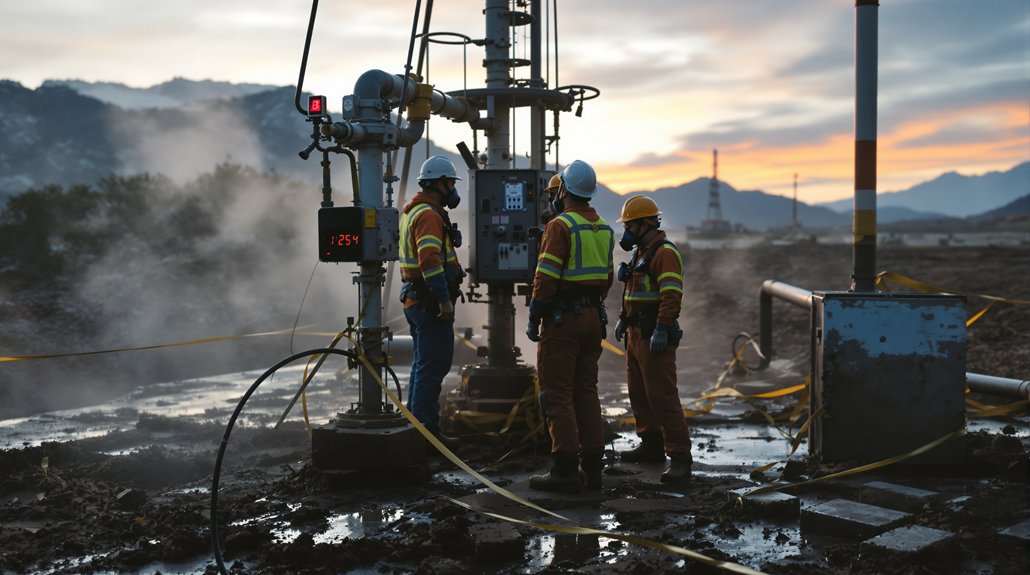
When you’re on site, treat any H2S indication as an immediate life-threatening hazard: evacuate downwind, stop work, shut sources if it’s safe, alert others, and don your escape respirator or self-contained breathing apparatus before re-entering. You’ll rely on H2S detection tools and personal monitors; check calibration and alarms during every shift. If an alarm sounds, execute your site-specific emergency response plan: account for personnel at the muster point, isolate the release if trained and it’s safe, and await qualified responders. Don’t attempt rescue without proper respiratory protection. Report incidents immediately through your chain of command and log detector readings and actions taken. Conduct brief, focused debriefs to confirm controls, re-establish safe work, and prevent recurrence. Additionally, ensure you have a valid H2S certification to demonstrate your training and preparedness for emergency situations.
H2S Risks on Drilling and Completion Sites in Alberta
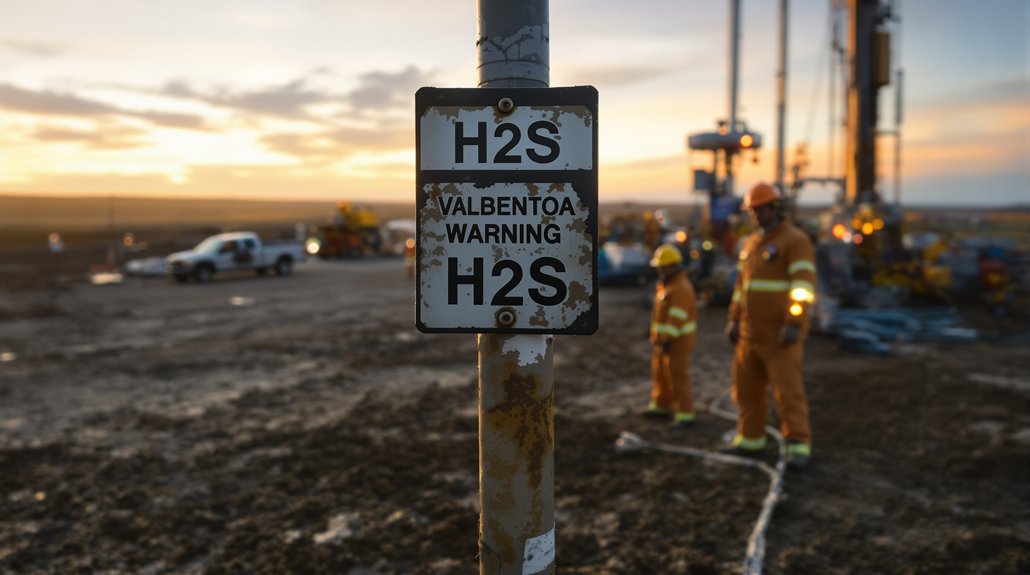
Because drilling and completion work disturbs formations and fluids, H2S can be released suddenly and unpredictably on-site, putting you and your crew at immediate risk of toxic exposure and equipment corrosion. You must treat every well as H2S‑potential until proven otherwise. During drilling operations, monitor gas returns, mud, and cuttings continuously; stop tripping or circulation if you detect sour gas. Use fixed and portable H2S detectors, enforce escape routes, and guarantee respirators and emergency kits are staged and maintained. For completion safety, purge and test lines before opening, isolate known sour zones, and control pressure to prevent kicks. Train crews on donning SCBAs, headcount procedures, and shutdown authority. Document incidents, corrective actions, and return-to-service criteria before resuming work. Additionally, ensure that all crew members possess a current H2S Alive certificate to validate their training and preparedness for handling H2S risks.
H2S Risks in Gas Plants and Sweetening Units (Worker Exposure Points)
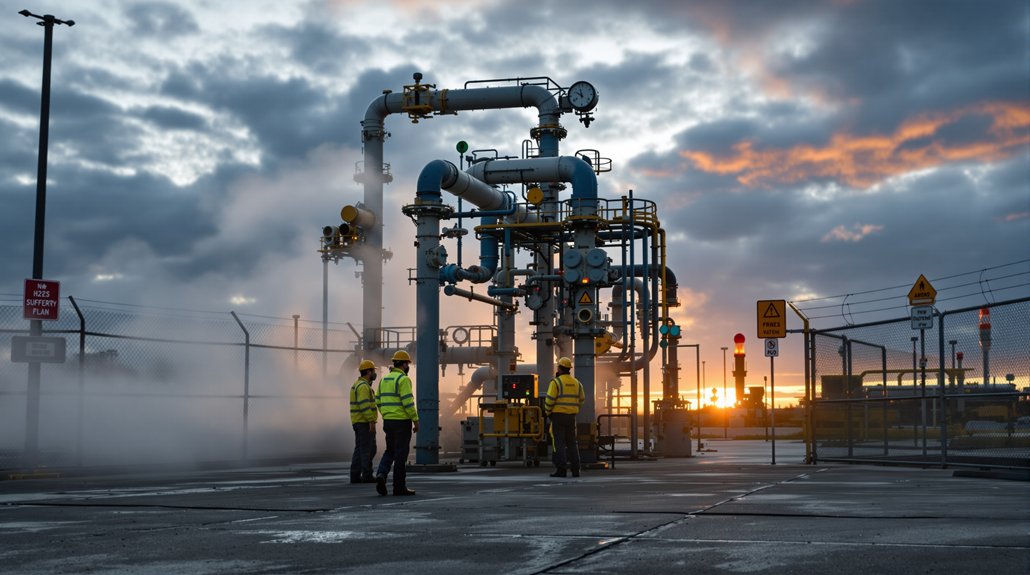
Although you may expect controlled conditions at gas plants and sweetening units, these facilities concentrate H2S and create multiple high‑risk exposure points that require constant vigilance. You’ll encounter H2S at inlet separators, amine contactors, regenerators, storage tanks, and drain sumps. Inspect seals, flanges, and instrument connections for leaks; monitor confined spaces before entry. Follow gas plant hazards procedures: use continuous fixed and portable detectors, maintain work permits, and enforce buddy systems. For sweetening unit safety, verify amine integrity, control purge and venting operations, and test for H2S during maintenance or turnaround. Don’t bypass personal protective equipment requirements—respiratory protection, H2S-rated detectors, and emergency escape gear are mandatory. Train regularly and rehearse emergency shutdown and rescue protocols. Additionally, ensure all workers are familiar with confined space entry protocols to minimize risks associated with H2S exposure.
H2S Risks on Pipelines, Valves, and During Pigging Operations
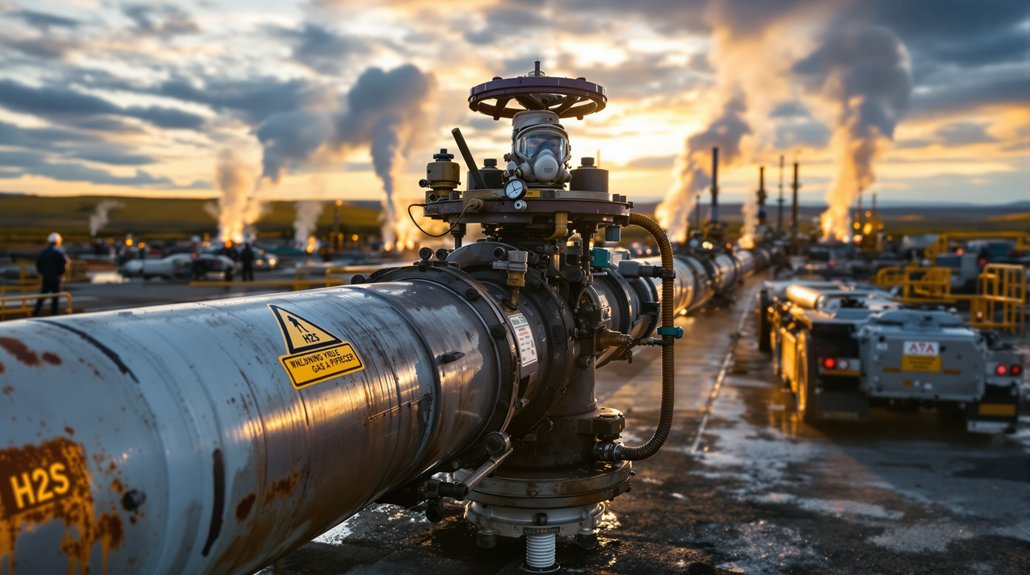
Pipelines, valves, and pigging operations concentrate H2S hazards and demand strict controls: you’ll find high H2S levels at valve packs, flange faces, low spots, debris traps, and inside pigs and pig launchers/receivers. You must follow a written procedure before entry or work: isolate and depressurize, purge with inert gas, verify zero H2S with a calibrated monitor, and lock/tag out. Inspect and document pipeline integrity regularly to prevent leaks and corrosion that release H2S. During valve maintenance, use gas-free verification and continuous monitoring; respirators and SCBA must be staged when monitoring indicates risk. For pigging, treat pigs as confined spaces: vent, purge, sample, and monitor launcher/receiver pockets. Train crews on emergency rescue, communication, and shut-in procedures.
H2S Accumulation in Produced‑Water Tanks, Pits, and Low‑Lying Areas
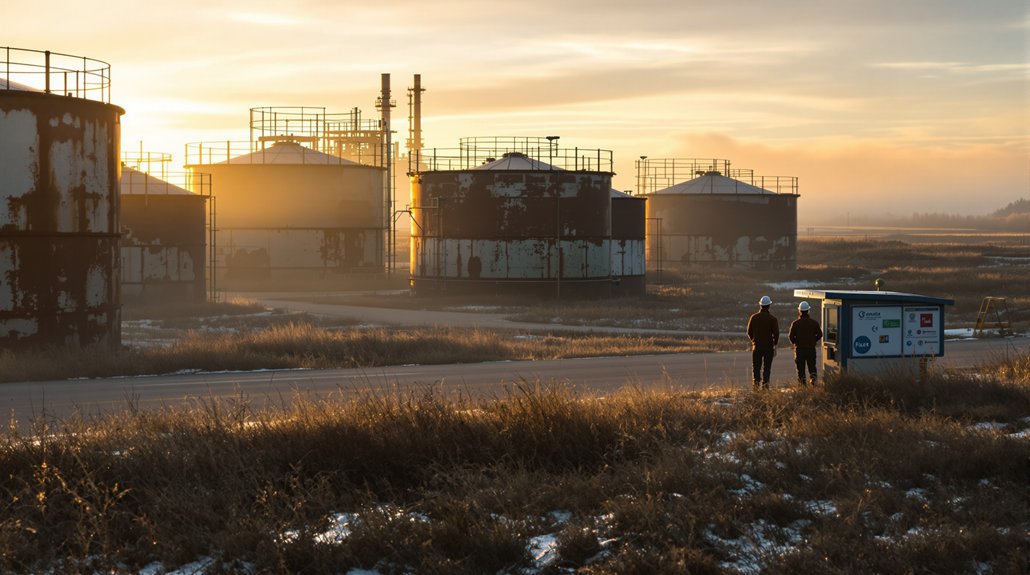
When produced-water tanks, retention pits, and low-lying areas are poorly ventilated or receiving sour fluids, H2S can accumulate quickly and create life‑threatening pockets at liquid and air interfaces. You must treat produced water safety as critical: inspect vents, monitor continuously, and control access. Use fixed and portable detectors at liquid surfaces and low points. Implement isolation and purge procedures before any entry or sampling. Train crews on low lying hazards and emergency response; enforce wind-direction and confined-area protocols. Don’t assume open air eliminates risk—H2S is heavier than air and pools.
| Action | Rationale |
|---|---|
| Vent verification | Prevents accumulation |
| Surface monitoring | Detects interface pockets |
| Lockout/tagout | Controls unexpected releases |
| Restrict access | Limits exposure |
| Response drills | Guarantees readiness |
H2S Accumulation in Enclosed Spaces, Trailers, and Vehicles
Produced-water pits and low spots aren’t the only places H2S will collect — enclosed spaces, trailers, and vehicles can trap concentrated gas quickly and silently. You must assume stagnant air in any confined or semi-confined unit. Before entry, check for sources: nearby vents, open fluids, or leaking equipment. Use procedural entry: test the atmosphere, purge when required, and keep entries short. Maintain clear trailer ventilation paths; don’t block vents with equipment or materials. In vehicles, avoid idling near potential leaks and park upwind when possible. Treat doors and seals as potential gas barriers—open slowly and monitor continuously. If detectors alarm or you sense odor, exit immediately and report. Prioritize vehicle safety and controlled, documented access.
Controls and Monitoring: PPE, Detectors, Ventilation, Permits, and Response
Because H2S can incapacitate you in minutes, you must rely on layered controls: appropriate PPE, fixed and portable detectors, engineered ventilation, formal entry permits, and an immediate response plan. Follow PPE Guidelines: wear rated respirators or SCBA, H2S-rated sensors on harnesses, flame-resistant clothing, and gas-tight gloves; inspect and fit-check equipment every shift. Use Monitoring Technologies: maintain calibrated fixed detectors with audible/visual alarms and carry portable multi-gas monitors set to H2S thresholds. Before entry, confirm ventilation achieves safe airborne limits; use forced-air where natural ventilation fails. Implement written hot work and confined-space permits, with continuous gas monitoring and a trained attendant outside. Train crews on alarm responses, evacuation routes, rescue protocols, and medical treatment for exposure. Stay disciplined; act immediately on alarms.
Frequently Asked Questions
Can H2S Cause Long-Term Health Effects After Low‑Level Exposures?
Yes — you can experience long term effects after low level exposures; document symptoms, get medical evaluation, monitor lung and neurological function, report exposures, follow occupational health guidance, and reduce future exposures to limit progressive respiratory or cognitive impairment.
Are There Legal Reporting Requirements for Near‑Miss H2S Incidents?
Yes — you must follow reporting protocols and notify regulators when required; you’ll complete near miss documentation per employer and Alberta OHS rules, promptly submit reports, and retain records for investigations and compliance audits.
How Do Contractors Verify H2S Competency of Third‑Party Workers?
You verify H2S competency of third‑party workers by reviewing certificates, conducting competency assessments, documenting contractor responsibilities, administering practical and theoretical testing, confirming refresher training, and keeping audited records to guarantee compliance and on-site readiness.
Do Home Carbon Monoxide Alarms Detect H2S Offsite Leaks?
No — you shouldn’t rely on home carbon monoxide alarms to detect H2S offsite leaks. For home safety, install dedicated H2S sensors, test detectors regularly, and follow manufacturer guidelines to guarantee alarm effectiveness and proper placement.
Can H2S Damage Equipment and Pipelines Over Time?
Yes — H2S causes corrosion effects that weaken metal and compromise pipeline integrity over time. You should inspect, monitor H2S levels, apply corrosion inhibitors, perform cathodic protection, and schedule regular maintenance to prevent failures.
